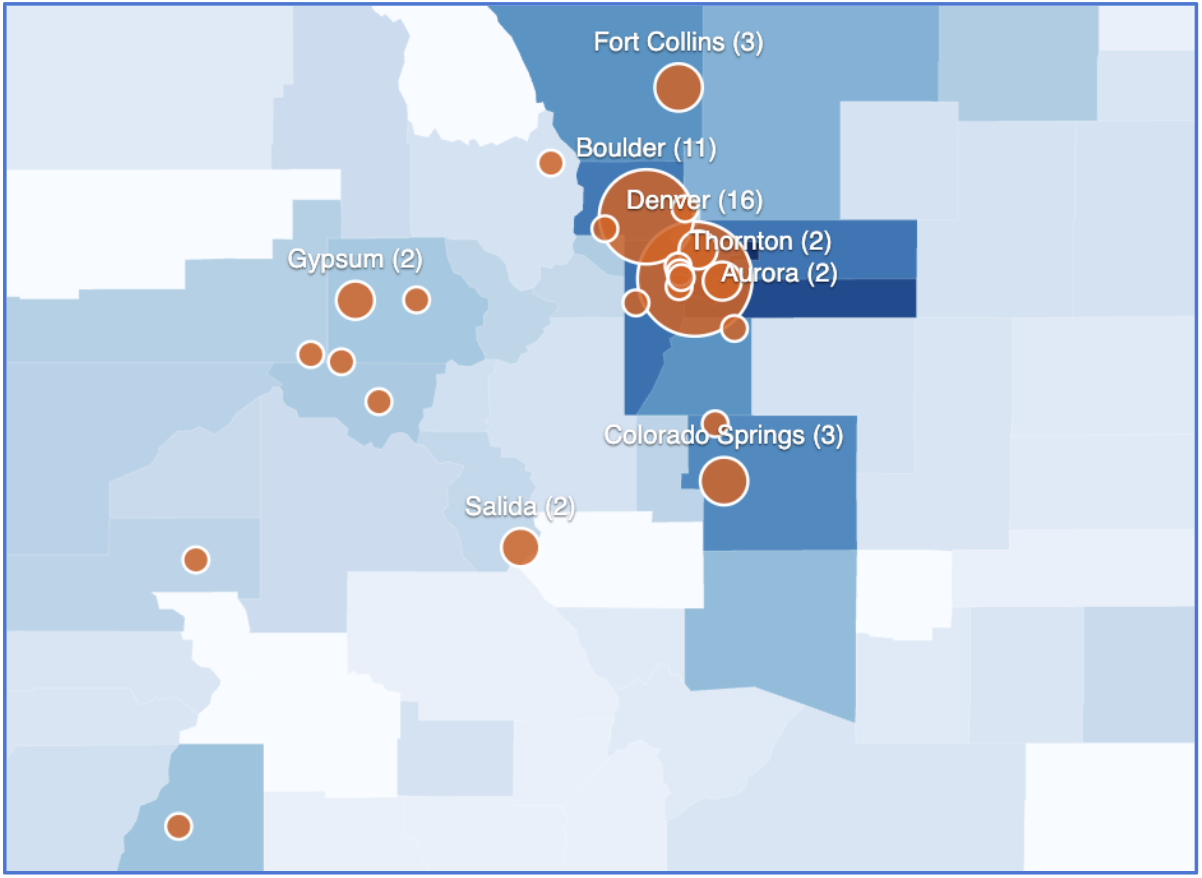
A look at where licensed facilitators are clustered, and where the gaps are.
Colorado made history in November 2022 when voters passed Proposition 122, legalizing regulated psilocybin services for adults. Since then, the state has built out a licensing framework, and a growing cohort of trained facilitators has earned credentials through the state’s Natural Medicine Health Act program. But as with many emerging regulated industries, the question of who actually has access—not just in law, but in practice—is more complicated than a ballot measure can answer.
We mapped the state’s 92 active licensed facilitators against Colorado’s population density, county by county. The picture that emerges is striking: facilitator coverage is heavily concentrated along the Front Range and in a handful of mountain resort communities, while large swaths of the state — home to tens of thousands of Coloradans — have no licensed facilitators at all.
Colorado map showing population density by county with facilitator locations overlaid as bubbles
The Front Range Has It Covered
Denver and Boulder alone account for 27 of Colorado’s 92 active facilitators — nearly 30% of the entire licensed workforce.
It’s no surprise that facilitators are clustering where the population is. Denver leads with 16 active licensees, followed by Boulder with 11. Jefferson County (which includes Lakewood, Arvada, Evergreen, and Nederland) contributes another four, and El Paso County (Colorado Springs) adds three more. Fort Collins and the Larimer County corridor round out the northern Front Range with three additional facilitators.
These are the densest, most educated, and most economically resourced parts of the state — and they reflect the demographics of early adopters in the psychedelic wellness space more broadly. For residents of the Front Range metro corridor, access to a licensed facilitator is increasingly realistic, even if not yet cheap or insurance-covered.
Mountain Corridors: Wealthy Access, Thin Coverage
Beyond the metro area, the next cluster of facilitators appears in Colorado’s mountain resort corridor — Aspen, Basalt, Carbondale, Edwards, and Gypsum each have one or two licensees. This reflects both the affluence and wellness-forward culture of the Roaring Fork and Eagle River valleys, where residents and visitors are accustomed to spending on premium health and therapeutic services.
Salida, in Chaffee County, is an interesting outlier — two facilitators serving a small but growing mountain town that has positioned itself as a hub for outdoor recreation and alternative wellness. Hesperus, in La Plata County near Durango, and Montrose in the Uncompahgre Valley, each have one facilitator serving their respective corners of the Western Slope.
The Gaps: Where the Map Goes Dark
Pueblo, with over 170,000 residents in its metro area, has zero active licensed facilitators.
Look at the map and the pattern is impossible to miss. Entire regions of Colorado — representing hundreds of thousands of residents — show deep blue population density with zero orange facilitator bubbles. These are not fringe or uninhabited corners of the state. They are communities with real populations and real need.
Pueblo is perhaps the most glaring example. Colorado’s sixth-largest city, with over 170,000 residents in its metro area, has no active licensed facilitators. The city has long struggled with economic disinvestment, high rates of addiction, and limited access to mental health services — precisely the population that early research suggests could benefit most from psilocybin-assisted therapy.
The San Luis Valley, one of the poorest regions in the state, is similarly uncovered. The Eastern Plains — Weld County aside — show virtually no facilitator presence despite scattered but real population centers in places like Greeley, Sterling, and La Junta. And across the Western Slope, outside of the resort corridor, coverage thins to nearly nothing.
Why This Matters
The distribution of facilitators in Colorado is, at this early stage, largely a market outcome. Facilitators tend to locate where clients can pay, where professional networks support their practice, and where cultural acceptance is highest. This is not unique to psilocybin services — it mirrors the distribution of psychotherapists, naturopaths, and other wellness practitioners across the state.
But the stakes here are potentially higher. Psilocybin-assisted services are being pursued, in part, as a response to a mental health crisis that is hitting rural and lower-income communities especially hard. If the regulatory model produces a therapy that is only accessible to affluent urban and resort-town residents, it risks deepening — rather than addressing — existing disparities in mental health care.
The Natural Medicine Advisory Board and the Colorado Department of Regulatory Agencies have an opportunity to monitor geographic equity as the industry matures. Sliding-scale licensing fees, rural training incentives, telehealth-adjacent models for preparation and integration, and community health partnerships could all play a role in expanding the map beyond its current Front Range footprint.
What to Watch
The facilitator registry is still young, and the number of licensees will grow as more cohorts complete training programs. The question worth tracking is not just whether the total number grows, but whether it grows in the places that need it most. Right now, the map tells a story of a promising new modality that, so far, looks a lot like every other premium wellness service Colorado has ever produced: concentrated, expensive, and unevenly distributed.
That can change. But it won’t change without intentional policy, investment, and accountability.
Data source: Colorado DORA Natural Medicine Facilitator License Registry. Analysis includes 92 active licensees across NMIT, NMCF, and NMF license types. Population density data from U.S. Census Bureau county estimates.
Find and reach out to a facilitator in your region (or perhaps near your region) on our directory here.